What Are Conversational Chatbots in Education?
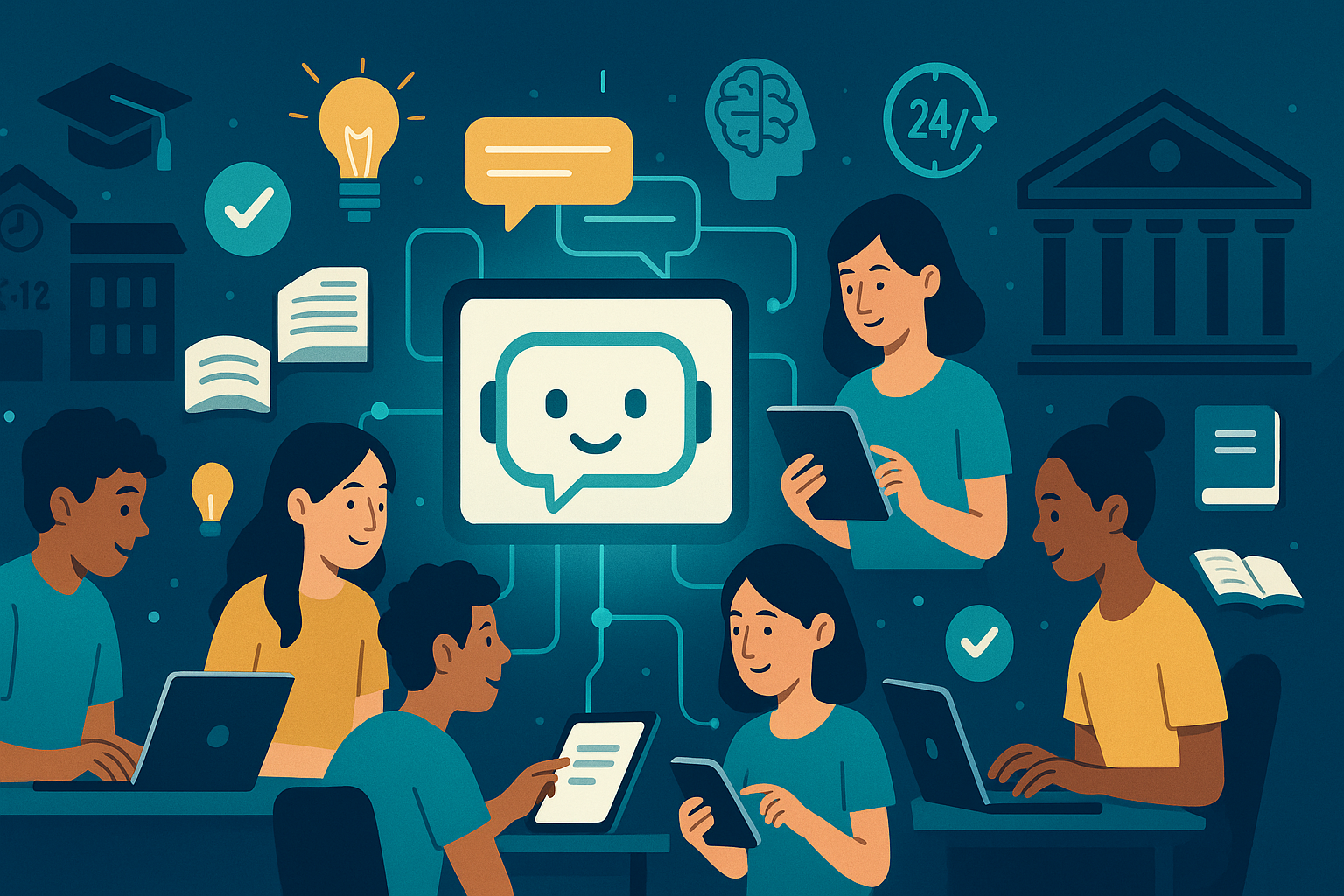
Conversational chatbots in education are AI-powered virtual assistants that interact with students and educators through natural language. Unlike traditional software, these chatbots can understand questions, provide personalized responses, and adapt to individual learning needs in real-time.The global AI in education market reached $5.88 billion in 2024 and is projected to hit $32.27 billion by 2030, growing at 31.2% annually—driven largely by demand for chatbot-based personalized learning and automated administrative support.
Key Statistics at a Glance
| Metric | Value |
| Market size (2024) | $5.88 billion |
| Projected market (2030) | $32.27 billion |
| Universities with institutional chatbots | 37% |
| K-12 teachers using AI chatbots | 51% |
| Enrollment increase (CSU with chatbot) | 5.6% |
---
How Are Chatbots Used in Education?
Educational chatbots serve multiple purposes across the learning ecosystem. Here are the primary use cases:
1. Personalized Tutoring and Learning
The most transformative application of chatbots in education is one-on-one personalized tutoring at scale.
Leading Examples:| Platform | Technology | Key Features |
| Khan Academy's Khanmigo | GPT-4 | Socratic tutoring, step-by-step guidance, never gives direct answers |
| Duolingo Max | GPT-4 | Conversational language practice, personalized error explanations |
| Quizlet Q-Chat | GPT-4 | Adaptive quizzes, conversational learning, real-time feedback |
2. Administrative Support and Student Services
Universities and schools use chatbots to handle routine inquiries, freeing staff for complex tasks.
Real-World Impact:- California State University's CSUNny: Built with 3,000+ topics, provides responses in 10-15 seconds, and contributed to a 5.6% increase in enrollment and graduation rates
- Georgia State's Pounce: The first major university chatbot, achieved a 22% reduction in summer melt (students who accept admission but never enroll)
- Thompson Rivers University: Chatbot handles 83% of application requests automatically
- Registration and enrollment queries
- Financial aid information
- Campus navigation
- Deadline reminders
- FAQ automation
3. 24/7 Learning Support
One of the most practical benefits of educational chatbots is round-the-clock availability. Students can access help at midnight before an exam or on weekends—times when human tutors are typically unavailable.
This is particularly valuable for:
- Students in remote or rural areas
- Working students with non-traditional schedules
- International students in different time zones
4. Skills Practice and Assessment
Chatbots enable low-stakes practice for skills that traditionally required human partners:
- Language conversation practice
- Interview preparation
- Presentation rehearsal
- Teacher-parent conference simulation
- Professional communication skills
5. Mental Health and Wellbeing Support
Some institutions deploy chatbots to provide:
- Self-help resources for stress and anxiety
- Initial mental health screening
- Anonymous access to counseling information
- Crisis resource referrals
---
What Does Research Say About Chatbot Effectiveness?
Positive Learning Outcomes
Research on AI chatbots in education shows promising results:
Meta-Analysis Findings (Wu and Yu, 2024):- Significant positive effect on learning performance
- Improved motivation and self-efficacy
- Increased interest and appreciation of learning
- Reduced anxiety
- Effectiveness rating: 4.24/5.0
- Ease of use rating: 4.28/5.0
- Impact on learning: 4.35/5.0
Learning Outcome Types
A systematic review of 37 studies on language learning with chatbots identified four outcome categories:
| Outcome Type | Percentage |
| Cognitive (knowledge, skills) | 43% |
| Emotional (motivation, attitudes) | 38% |
| Behavioral (engagement, persistence) | 15% |
| Agentic (self-regulation, autonomy) | 4% |
Collaborative Learning Effects
Research on computer-supported collaborative learning found that chatbot involvement: Positives:- Enhanced reflection and critical thinking
- Improved creativity and problem-solving
- Increased cohesion among team members
- Higher discussion intensity
- Increased learning burden
- Learner fatigue with extended use
---
University Chatbot Implementation Examples
United States
| Institution | Chatbot | Implementation | Results |
| UC Irvine | ZotGPT | Multi-LLM platform (Jan 2024) | 15,000 unique users |
| University of Michigan | UM-GPT | First institution-scale AI (Aug 2023) | Private Azure deployment |
| Arizona State | CreateAI | 50+ generative AI models | Custom AI project builder |
| Georgia State | Pounce | Enrollment assistance | 22% reduction in summer melt |
International Examples
| Institution | Country | Chatbot | Results |
| University of Murcia | Spain | AI Assistant | 38,708 inquiries, 91% accuracy |
| University of Galway | Ireland | Cara | 24/7 virtual assistant |
| Staffordshire University | UK | Beacon | 400+ FAQs since 2019 |
---
Chatbots in K-12 Education
Current Adoption
Within two months of ChatGPT's launch:
- 51% of K-12 teachers reported using it
- 40% use AI chatbots at least weekly
- 53% anticipated increased future use
Benefits for K-12
- 1Personalized Learning at Scale
- Adapts to different learning paces
- Provides differentiated instruction automatically
- Rewrites content at appropriate reading levels
- 2Teacher Time Savings
- McKinsey estimates AI can reduce prep time from 11 hours to 6 hours per week
- Automates routine assessment and feedback
- Handles repetitive student questions
- 3Extended Learning Hours
- 24/7 availability for homework help
- Particularly valuable for rural/remote students
Challenges for K-12
| Challenge | Concern |
| Academic Integrity | 25%+ teachers have caught students using chatbots to cheat |
| Limited Research | Effects on younger children's development unclear |
| Equity Gaps | Lower-income schools may lack equal access |
| Social Learning | Individual AI tutoring may reduce collaborative benefits |
---
Ethical and Privacy Concerns
Data Privacy Issues
Key Concerns:- 1Outdated Regulations: FERPA (1974) hasn't been significantly updated for AI
- 2Unauthorized Use: Many teachers use AI tools without district approval
- 3Data Sharing: AI companies may share data with third parties
- 4Breach Risks: Example - 444,000 students exposed in a proctoring platform hack
Ethical Challenges
According to research in Frontiers in Education:
- Data privacy violations
- Algorithmic bias in responses
- Educational inequality in access
- Academic integrity concerns
- Loss of critical thinking skills from overreliance
- Diminished human connection in learning
Student Concerns
A 2025 study identified student worries about:- Accuracy of AI-generated information
- Development of overreliance
- Preservation of human elements in education
- Data privacy and system bias
- Environmental impact of AI systems
---
Best Practices for Implementation
For Educational Institutions
- 1Align with Institutional Goals
- Define clear objectives before deployment
- Identify specific problems the chatbot will solve
- 2Ensure Quality Data
- Use context-specific, accurate training data
- Regularly audit chatbot responses for accuracy
- 3Maintain Human Oversight
- Never fully automate critical educational decisions
- Regular review by educators and administrators
- 4Embed in Core Systems
- Integrate with existing LMS and student information systems
- Avoid standalone implementations
- 5Monitor and Iterate
- Track usage analytics and student feedback
- Continuously improve based on real-world performance
For Educators
- 1Start Small: Begin with one use case (e.g., FAQs or homework help)
- 2Set Clear Guidelines: Establish policies for student AI use
- 3Maintain the Human Touch: Use AI as an assistant, not a replacement
- 4Teach AI Literacy: Help students understand AI capabilities and limitations
For Policymakers
- 1Develop Comprehensive AI Policies addressing data privacy
- 2Form AI Ethics Committees to monitor compliance
- 3Ensure Regulatory Compliance with FERPA, COPPA, GDPR
- 4Bridge Equity Gaps in AI access across schools
---
Opportunities for Pakistan: Why Chatbots Matter Here
Pakistan faces unique educational challenges that make conversational AI particularly valuable:
The Scale of the Challenge
| Metric | Pakistan's Reality |
| Out-of-school children | 20+ million (2nd highest globally) |
| Teacher shortage | Over 500,000 vacant positions |
| Student-teacher ratio | 40:1 average, up to 80:1 in rural areas |
| Education spending | 0.8% of GDP (lowest in region) |
Why Chatbots Are a Game-Changer for Pakistan
1. Addressing Teacher ShortagesWith over 500,000 unfilled teaching positions, AI chatbots can provide:
- Supplementary tutoring where teachers are unavailable
- 24/7 homework help in underserved areas
- Consistent quality instruction across regions
Students in rural Sindh, Balochistan, and Khyber Pakhtunkhwa often have limited access to qualified teachers. AI tutoring can:
- Deliver curriculum-aligned content to remote villages
- Work offline once downloaded
- Provide instruction in Urdu, Pashto, Sindhi, Balochi, and regional languages
AI chatbots aligned with SNC can ensure:
- Consistent curriculum delivery across provinces
- Standardized assessment quality
- Reduced preparation burden for teachers adapting to new curriculum
Rather than replacing teachers, chatbots can:
- Reduce planning time by 50% or more
- Handle routine student questions
- Allow teachers to focus on mentorship and complex instruction
With limited education budgets, AI offers:
- Lower per-student cost than hiring additional teachers
- Scalability to reach millions simultaneously
- One-time development with ongoing benefits
Success Factors for Pakistan
For chatbots to succeed in Pakistani education:
- 1Local Language Support: Must work in Urdu and regional languages
- 2Offline Capability: Internet penetration remains limited in rural areas
- 3Curriculum Alignment: Must follow SNC and provincial board requirements
- 4Cultural Sensitivity: Content must be appropriate for Pakistani context
- 5Mobile-First Design: Most users will access via smartphones
PakEdX's Role in This Transformation
PakEdX is building AI-powered educational tools specifically designed for Pakistani teachers, addressing these unique requirements with:- Full SNC alignment
- Urdu and English support
- Board-specific content (Punjab, Sindh, KPK, Balochistan, Federal, Cambridge)
- Free tier ensuring accessibility
---
How PakEdX Uses Conversational AI
At PakEdX, we've built AI-powered tools specifically for Pakistani educators that embody best practices in educational AI:
Our Approach
| Feature | Implementation |
| Curriculum Alignment | SNC, Punjab, Sindh, KPK, Balochistan, Federal Board integration |
| Language Support | Full Urdu and English support |
| Misconception-Based Distractors | Quiz questions designed to diagnose understanding |
| Bloom's Taxonomy Alignment | Questions across all 6 cognitive levels |
| Grade-Calibrated Language | Vocabulary matched to student level |
| Teacher Empowerment | AI as assistant, never replacement |
Why This Matters
While global chatbot platforms focus on general education, PakEdX is built specifically for Pakistani curriculum—understanding SNC requirements, provincial board variations, and local educational context.
---
Frequently Asked Questions (FAQ)
What are educational chatbots?
Educational chatbots are AI-powered virtual assistants that interact with students and educators through natural language conversation. They can answer questions, provide tutoring, handle administrative tasks, and offer personalized learning support 24/7.
How do chatbots improve learning outcomes?
Research shows chatbots improve learning through:
- Personalized, adaptive instruction
- Immediate feedback on performance
- 24/7 availability for practice and questions
- Reduced anxiety in low-stakes environments
- Increased student engagement and motivation
What is the best AI chatbot for education?
Leading educational chatbots include:
- Khanmigo (Khan Academy) - Best for Socratic tutoring
- Duolingo Max - Best for language learning
- Quizlet Q-Chat - Best for quiz practice
- PakEdX - Best for Pakistani curriculum
Are chatbots replacing teachers?
No. Research consistently shows that chatbots work best as teaching assistants, not replacements. The most effective implementations augment teacher capabilities while preserving the irreplaceable human elements of education: emotional connection, mentorship, and relationship building.
What are the risks of AI chatbots in schools?
Key risks include:
- Data privacy concerns
- Academic integrity issues
- Potential for inaccurate information
- Overreliance reducing critical thinking
- Equity gaps in access
How much does educational AI cost?
Costs vary widely:
- Free options: Khan Academy's Khanmigo (for teachers), ChatGPT free tier
- Premium individual: $10-30/month (Duolingo Max, Quizlet Plus)
- Institutional licenses: Contact-based pricing
- PakEdX: Free tier (5 lessons + 5 quizzes/month), Professional from Rs. 2,499/month
Is AI tutoring effective for K-12 students?
Research shows positive effects, but with caveats:
- Effects are stronger in higher education than K-12
- Short-term interventions show larger effects (possible novelty factor)
- Limited research on long-term effects on young children
- Social learning benefits may be reduced with individual AI tutoring
---
The Future of Conversational AI in Education
Near-Term Trends (2026-2027)
- Institution-specific LLMs: More universities building private AI deployments (like UM-GPT, ZotGPT)
- Course-integrated chatbots: AI that understands specific curricula and textbooks
- Multimodal capabilities: Chatbots that process images, voice, and video
- Regulatory evolution: New frameworks addressing AI in education
Long-Term Vision (2028-2030)
- AI-human collaborative teaching: Seamless integration where AI handles routine tasks, humans focus on mentorship
- Predictive learning analytics: AI identifying struggling students before they fail
- Universal accessibility: Voice-first interfaces making education accessible to all
- Personalized learning paths: AI designing individual curricula based on learning style and goals
---
Conclusion
Conversational chatbots represent one of the most significant technological shifts in education since the internet. With proper implementation—prioritizing data privacy, maintaining human oversight, and ensuring equitable access—AI chatbots can:
- Democratize tutoring previously available only to the privileged
- Free teachers from routine tasks to focus on mentorship
- Provide 24/7 support to students worldwide
- Personalize learning at unprecedented scale
The key is thoughtful implementation that treats AI as a powerful tool in service of human educators—not a replacement for them.
Ready to explore AI-powered education? Try PakEdX free and experience curriculum-aligned AI lesson plans and assessments designed for Pakistani educators.---
References and Further Reading
- 1Role of AI chatbots in education: Systematic literature review - International Journal of Educational Technology in Higher Education
- 2AI Chatbots in Education: Challenges and Opportunities - MDPI Information
- 3How Three Universities Developed Their Chatbots - EdTech Magazine
- 4The Rise of Chatbots in Higher Education - Ohio State University
- 5Top Use Cases of Conversational AI in Education - AIMultiple Research
- 6Chatbot as a Teaching Tool - Stanford Teaching Resources
- 7How students' privacy could be a casualty of schools' rush to AI - Axios
- 8Ethical and regulatory challenges of Generative AI in education - Frontiers in Education
- 9Student Perspectives on the Benefits and Risks of AI in Education - arXiv
- 10Impacts of AI Chatbots on Students' Learning Outcomes - College Teaching