
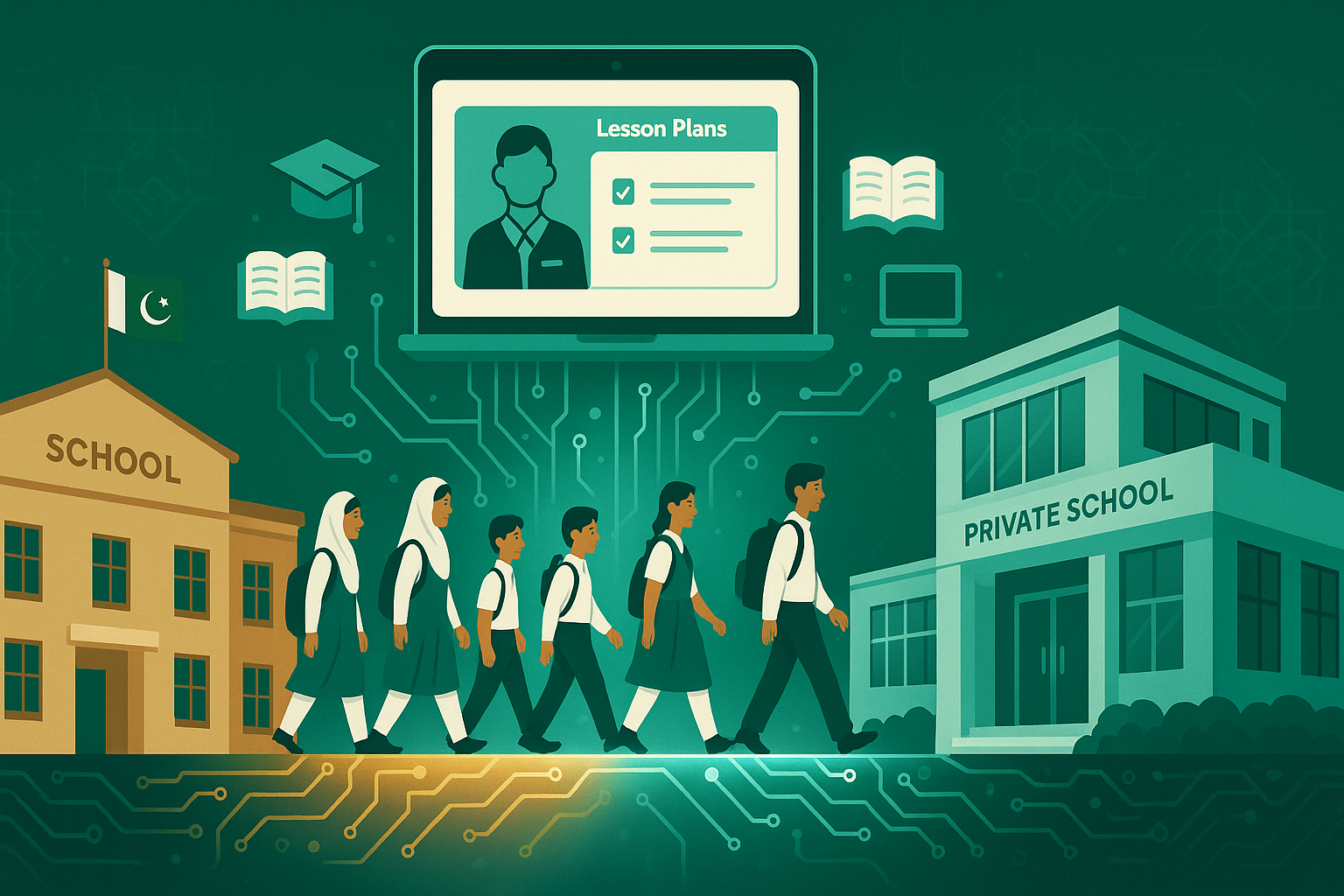
Pakistan's Education at a Crossroads: Understanding the Privatization Debate
Pakistan has become ground zero for one of the world's largest public school outsourcing experiments. In 2024-2025, the Government of Punjab announced plans to transfer nearly 14,000 public schools—approximately 30% of all its schools—to NGOs and private operators through the Punjab Education Foundation (PEF).This article examines Pakistan's school privatization debate, explores the constitutional and practical implications, and proposes how digital education platforms like PakEdX can offer a balanced "third way" that empowers teachers in both public and private sectors.
---
What is Happening? Punjab's School Privatization Explained
The Scale of Change
| Phase | Schools Transferred | Timeline |
| Phase 1 | 5,863 schools | 2024 |
| Phase 2 | 4,453 schools | 2024-2025 |
| Phase 3 | 15,000+ schools | 2025 onwards |
| Total Planned | ~30% of all Punjab schools | By 2026 |
Under this arrangement, the government pays Rs. 650-900 per student monthly to PEF-selected private contractors, who become responsible for providing teachers and resources.
Government's Rationale
Chief Minister Maryam Nawaz and Education Minister Hayat argue that privatization will:
- 1Improve educational outcomes through competition
- 2Bring 1.8 million out-of-school children back into education
- 3Provide world-class education free of cost to underprivileged students
- 4Enhance school conditions and academic results
Opposition's Concerns
Teachers' associations across Punjab have condemned the policy, calling it a "cruel act" that violates constitutional obligations. Key concerns include:
- Constitutional violation: Article 25A guarantees free education as a fundamental right
- Teacher job security: Mass displacement of government teachers
- Quality inconsistency: Research shows private school quality "wildly varies"
- Equity concerns: May further marginalize the poorest students
- Accountability gaps: Private operators may prioritize profit over education
---
Article 25A: Pakistan's Constitutional Right to Education
What Does Article 25A Say?
> "The State shall provide free and compulsory education to all children of the age of five to sixteen years in such manner as may be determined by law."
This article, inserted through the 18th Constitutional Amendment in 2010, made education a justiciable fundamental right for the first time in Pakistan's history.
The Constitutional Tension
Critics argue that privatization contradicts Article 25A because:
- 1The STATE must provide education—not delegate to private parties
- 2"Free" education may become conditional on private operators' discretion
- 3Compulsory attendance becomes harder to enforce across fragmented private networks
- 4Accountability for failure becomes diffuse when outsourced
Supporters counter that Article 25A says "in such manner as may be determined by law"—leaving room for public-private partnerships as delivery mechanisms.
---
Pakistan's Education Crisis: The Numbers
Out-of-School Children
| Year | Out-of-School Children | Percentage |
| 2022 | 25.3 million | 30% |
| 2024 | 27 million (Punjab) | Increased |
| 2025 | 20 million (national) | 28% |
Despite government claims of progress, Pakistan has the second-highest rate of out-of-school children globally, with over 40% not attending school in some regions.
Education Spending
Pakistan's education spending hit a record low of 0.8% of GDP in 2024-25—far below the recommended 4-6% and insufficient to meet constitutional obligations.Gender Disparities
- 1 in 4 boys remain out of school
- 1 in 3 girls remain out of school
- Rural girls in Sindh and Balochistan face the highest exclusion rates
---
The Case FOR Privatization: What Supporters Argue
Punjab Education Foundation's Track Record
The PEF model isn't new—it began in 2005 and has some achievements:
- 1Foundation Assisted Schools (FAS): Supports 1.6+ million students in 3,200+ partner schools
- 2Education Voucher Scheme (EVS): Enables low-income families to choose private schools
- 3New School Programme (NSP): Establishes schools in underserved areas with no formal education access
- 4Performance incentives: Schools with high pass rates receive monetary awards
Research Evidence (Pro-Privatization)
Some studies suggest that:
- Low-cost private schools achieve similar or better outcomes at lower per-pupil costs
- Competition can drive improvement in public school performance
- Private sector brings entrepreneurial efficiency and innovation
---
The Case AGAINST Privatization: What Critics Argue
Research Evidence (Anti-Privatization)
> "The evidence to back such reform at a staggering scale is, at best, limited. Globally, research on outsourcing public schools shows inconsistent impacts."
> — UK Forum for International Education and Training (UKFIET), 2025
Key Concerns
- 1Quality Variability: Research on the "private school premium" in Pakistan shows quality wildly varies across private schools
- 2Teacher Exploitation: Private contractors may hire unqualified teachers at low wages
- 3Cherry-Picking: Private operators may avoid difficult-to-educate students
- 4Democratic Accountability: Citizens lose direct control over public education
- 5Profit Motive: Education becomes a commodity rather than a right
UN Concerns
Multiple UN committees have expressed concern over Pakistan's privatization trajectory, noting its potential implications for the right to education under international human rights frameworks.
---
The Third Way: Digital Education as a Bridge
Why Digital Education Matters Now
Rather than framing the debate as "public vs. private," digital education platforms offer a third way that can:
- 1Empower teachers in BOTH sectors with quality resources
- 2Standardize curriculum delivery regardless of school type
- 3Reduce dependence on individual school quality
- 4Democratize access to world-class teaching tools
- 5Support Article 25A compliance through scalable solutions
Pakistan's EdTech Landscape
Pakistan has 707 EdTech companies, including platforms like:
- Taleemabad: Video-based learning for K-12
- Maqsad: Pakistan's highest-funded EdTech ($4.9M raised)
- Edkasa: Online test preparation
- TeleSchool: Government-backed TV/app-based learning
- PakEdX: AI-powered lesson plans and assessments for teachers
Government Digital Initiatives
The Digital Pakistan Vision focuses on five pillars:
- 1Access and connectivity
- 2Digital infrastructure
- 3E-government
- 4Digital skills
- 5Innovation
UNICEF's Learning Passport programme, developed with Microsoft, aims to close the learning poverty gap through digital platforms.
---
How PakEdX Fits Into This Debate
Our Philosophy: Empower Teachers, Not Replace Them
PakEdX doesn't take sides in the public-private debate. We serve teachers in BOTH sectors.Whether you teach in a:
- Government school struggling with resources
- Low-cost private school with minimal training support
- Elite private school seeking curriculum alignment
- PEF partner school navigating new requirements
What PakEdX Offers
| Feature | How It Helps |
| AI Lesson Plans | SNC-aligned plans in minutes, not hours |
| Quiz Generator | Research-backed assessments with Bloom's taxonomy alignment |
| Urdu Support | Full RTL rendering for Urdu-medium instruction |
| Board Alignment | Federal, Punjab, Sindh, KPK, Cambridge support |
| Free Tier | 5 lessons + 5 quizzes monthly—no financial barrier |
| Offline Export | PDF/print options for schools without internet |
Why This Matters for the Privatization Debate
The quality gap between schools often comes down to teacher preparation time and resources.A government school teacher with 40 students and no planning period can now create the same quality lesson plan as a private school teacher with extensive support staff.
Digital tools level the playing field.---
Policy Recommendations: A Balanced Approach
For Government
- 1Regulate, don't just delegate: Ensure private operators meet quality standards
- 2Invest in teacher training: Technology adoption requires training
- 3Mandate digital literacy: Include EdTech skills in teacher certification
- 4Monitor outcomes: Track learning outcomes, not just enrollment
- 5Protect teacher rights: Ensure fair employment in privatized schools
For Schools (Public and Private)
- 1Adopt AI teaching tools: Reduce teacher workload while improving quality
- 2Focus on outcomes: Use data to identify struggling students early
- 3Collaborate across sectors: Share best practices between public and private
- 4Engage parents: Digital platforms can extend learning to homes
For Teachers
- 1Embrace technology: AI tools are assistants, not replacements
- 2Upskill continuously: The digital education landscape is evolving
- 3Advocate for rights: Technology adoption shouldn't mean job insecurity
- 4Focus on pedagogy: Tools handle logistics; you handle relationships
For EdTech Platforms
- 1Design for low-bandwidth: Many Pakistani schools lack reliable internet
- 2Support local languages: Urdu, Sindhi, Pashto, Punjabi matter
- 3Align with curriculum: SNC compliance is non-negotiable
- 4Price for accessibility: Free tiers enable universal access
- 5Train teachers: Technology without training is shelf-ware
---
The Future: What Could Pakistan's Education Look Like?
Scenario 1: Privatization Succeeds
If the Punjab experiment works:
- Model expands to other provinces
- Private sector investment increases
- Quality improves through competition
- But: Risk of two-tier system (quality private vs. struggling public)
Scenario 2: Privatization Fails
If outcomes don't improve:
- Government reverses course
- Massive disruption to teacher employment
- Lost years for a generation of students
- Political backlash
Scenario 3: Digital Education Bridges the Gap
If platforms like PakEdX gain adoption:
- Teacher quality becomes less school-dependent
- Curriculum standardization improves across sectors
- Students access consistent quality regardless of school type
- Public-private debate becomes less polarized
---
Conclusion: Beyond the Binary
The public-private education debate in Pakistan often presents a false binary:
- Either the state provides education directly
- Or the private sector delivers it for profit
When every teacher—public or private, urban or rural, Urdu-medium or English-medium—has access to AI-powered curriculum-aligned tools, the quality gap narrows.
PakEdX exists to make this possible.We don't solve the policy debate. We equip teachers on both sides with the tools they need to deliver quality education regardless of which system ultimately prevails.
Because ultimately, this isn't about systems.
It's about 20 million children who deserve to learn.---
Frequently Asked Questions
Is school privatization legal under Article 25A?
Article 25A mandates free education but allows flexibility in delivery mechanisms. Legal scholars disagree on whether privatization complies. The key test is whether education remains genuinely free and accessible to all children.
How many schools is Punjab privatizing?
Punjab plans to transfer approximately 14,000 schools (30% of all schools) to private operators through the Punjab Education Foundation by 2026, with potential expansion to 100% of primary schools.
What is the Punjab Education Foundation (PEF)?
PEF is a semi-autonomous body established in 1991 that facilitates public-private partnerships in education. It operates programs like Foundation Assisted Schools (FAS), Education Voucher Scheme (EVS), and the New School Programme (NSP).
How does PakEdX help in this situation?
PakEdX provides AI-powered lesson planning and assessment tools that work equally well for teachers in public schools, private schools, and PEF partner schools—ensuring quality education resources are accessible regardless of the privatization debate's outcome.
What are the out-of-school children statistics for Pakistan?
As of 2025, approximately 20 million children (28% of school-age population) remain out of school in Pakistan, with higher rates among girls (1 in 3) compared to boys (1 in 4).
---
References
- 1UKFIET. (2025). "Punjab's great gamble: Will the huge public-school-outsourcing experiment pay off?"
- 2Dawn News. (2024). "Privatisation of 13,000 schools: Govt to pay monthly Rs650 per student to private sector in Punjab"
- 3Express Tribune. (2024). "Privatisation woes mark a troubled year for education"
- 4Constitution of Pakistan. "Article 25A: Right to education"
- 5UNICEF Pakistan. "Education"
- 6EdTech Hub. "Education Technology in Pakistan"
- 7Save the Children. (2025). "Education Spending in Pakistan Hits New Low"
- 8Asian Development Bank. "Public-Private Partnerships in Education: Lessons Learned from the Punjab Education Foundation"